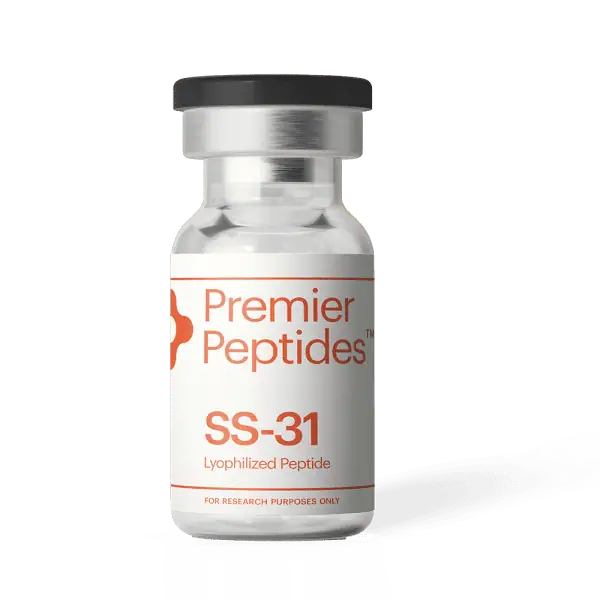
SS-31 (Elamipretide) is a mitochondria-targeting peptide that protects cells from oxidative stress and enhances ATP production. It supports energy metabolism, reduces inflammation, and promotes cellular resilience. SS-31 is often used for its anti-aging potential and ability to improve muscular and cardiovascular performance at the mitochondrial level.
SS 31 peptide, also known as Elamipretide, is a synthetic tetrapeptide studied in laboratory research involving mitochondrial function, mitochondrial dysfunction, oxidative stress, cellular energy, ATP production, cardiolipin biology, and mitochondrial membrane stability.
In scientific literature, SS-31 is often discussed for its relationship to the inner mitochondrial membrane, phospholipid cardiolipin, cytochrome c activity, mitochondrial reactive oxygen species, oxidative phosphorylation, and mitochondrial bioenergetics.
PremierPeptides™ supplies SS-31 under strict quality control standards for laboratory and scientific research only.
Research use only. Not for human or animal consumption.
Mitochondrial Dysfunction and SS-31 Research
Mitochondria play a critical role in cellular energy production. They are responsible for generating adenosine triphosphate, commonly known as ATP, through the oxidative phosphorylation system.
Mitochondrial dysfunction is studied across many research areas because changes in mitochondrial respiration, redox homeostasis, mitochondrial membrane structure, oxidative stress, and energy metabolism may affect cell performance and tissue resilience.
SS-31 is frequently evaluated in research models involving:
Mitochondrial dysfunction
Mitochondrial reactive oxygen species
Mitochondrial membrane stability
Oxidative phosphorylation
Mitochondrial ATP production
Cellular energy pathways
Redox homeostasis
Respiratory chain supercomplexes
These research applications make SS-31 relevant to studies involving cellular stress, aging models, heart disease pathways, skeletal muscle function, kidney injury models, and mitochondrial disease research.
SS 31 and the Inner Mitochondrial Membrane
One of the key reasons SS-31 is studied is its relationship to the inner mitochondrial membrane.
Elamipretide is commonly described as a mitochondria-targeting peptide that interacts with cardiolipin, a phospholipid found in the inner mitochondrial membrane. Cardiolipin plays a functional role in maintaining mitochondrial structure, cristae structure, electron transport chain organization, and ATP synthesis.
Researchers may evaluate SS-31 in relation to:
Inner mitochondrial membrane structure
Cardiolipin remodeling
Cristae structure
Respiratory supercomplexes
Complex I, Complex III, and Complex IV activity
Mitochondrial proteins
Electron transport chain function
This mechanism is distinct from many other peptides. SS-31 is not studied primarily as a growth hormone peptide, fat loss peptide, or muscle growth peptide. Its research focus is mitochondrial structure, mitochondrial bioenergetics, and oxidative stress response.
ATP Production and Energy Metabolism
ATP production is central to SS-31 research. ATP, or adenosine triphosphate, is the main cellular energy molecule used by cells to power essential biological processes.
Because mitochondria are responsible for most cellular ATP synthesis, researchers study SS-31 in models involving mitochondrial ATP production, mitochondrial respiration, oxidative phosphorylation, respiratory control ratio, and energy metabolism.
SS-31 research may be relevant to experimental models involving:
Cellular energy production
Mitochondrial respiration
Oxidative phosphorylation efficiency
ATP synthesis
Energy metabolism
Mitochondrial bioenergetics
Age-related mitochondrial decline
Research involving ATP production may also intersect with cellular recovery and oxidative stress models, especially where investigators are studying tissue resilience, inflammation, and repair-related biological pathways.
Cytochrome C, Cardiolipin, and Redox Homeostasis
Cytochrome c is an important mitochondrial protein involved in electron transport and oxidative phosphorylation. Its interaction with cardiolipin is a major area of mitochondrial research.
SS-31 is studied for its ability to interact with cardiolipin and influence cardiolipin-cytochrome c function. This relationship is relevant to mitochondrial membrane stability, electron carrier function, reactive oxygen species control, and redox homeostasis.
In laboratory models, researchers may examine how SS-31 affects:
These mechanisms are studied in cells, isolated mitochondria, animal models, and clinical research contexts. They should not be interpreted as human-use claims, medical benefits, or treatment effects.
Mitochondria Isolated and Experimental Models
SS-31 is commonly studied in experimental systems involving mitochondria isolated from cells, tissues, or animal models. These models allow researchers to examine mitochondrial respiration, ATP synthesis, complex activity, oxidative stress, and membrane dynamics under controlled conditions.
In isolated mitochondria research, investigators may measure:
Respiratory control ratio
Oxygen consumption
ATP production
Oxidative phosphorylation
Mitochondrial membrane potential
Reactive oxygen species production
Complex I, Complex III, and Complex IV activity
These studies help researchers determine how SS-31 may affect mitochondrial performance at a cellular or subcellular level.
Findings from isolated mitochondria, aged mice, acute kidney injury models, or other animal models should not be presented as clinical outcomes for humans.
Mass Spectrometry and Mitochondrial Analysis
Mass spectrometry may be used in mitochondrial research to analyze proteins, lipids, metabolites, and molecular changes related to mitochondrial function.
In SS-31 research, analytical techniques such as mass spectrometry can support investigation into cardiolipin remodeling, mitochondrial proteins, respiratory chain supercomplexes, oxidative stress markers, and cellular energy metabolism.
Researchers may use these tools to better understand:
Cardiolipin composition
Mitochondrial protein expression
Oxidative stress markers
Metabolic pathway changes
Respiratory chain organization
Differences between treatment and control groups
Terms such as statistically significant differences, p value, error bars, and two groups are common in this type of research reporting. PremierPeptides™ does not interpret lab results, provide study design advice, or make claims of efficacy for human use.
Beneficial Effects in Research Context
SS-31 is often discussed in scientific literature for potential beneficial effects in mitochondrial research. These effects are generally studied in relation to mitochondrial structure, ATP production, oxidative stress, respiratory function, and tissue-specific mitochondrial performance.
Research areas commonly associated with SS-31 include:
Aging-related mitochondrial decline
Skeletal muscle mitochondrial function
Heart failure research
Acute kidney injury models
Neuroinflammation models
Primary mitochondrial myopathy research
Barth syndrome research
Mitochondrial disease models
Some studies in aged mice have examined SS-31 in relation to skeletal muscle mitochondrial energetics, oxidative stress, and muscle function. Other research has evaluated Elamipretide in human clinical trial settings for primary mitochondrial myopathy, heart failure, kidney-related endpoints, and Barth syndrome.
These research findings do not mean SS-31 is approved for anti-aging, muscular performance, cardiovascular performance, cognitive support, or medical treatment through PremierPeptides™.
Barth Syndrome, Primary Mitochondrial Myopathy, and Clinical Trials
SS-31, or Elamipretide, has been evaluated in clinical trials involving mitochondrial dysfunction conditions, including Barth syndrome and primary mitochondrial myopathy.
Barth syndrome is relevant to SS-31 research because it involves cardiolipin-related mitochondrial dysfunction. Since SS-31 is studied for its interaction with cardiolipin, researchers have investigated its potential role in this area.
Primary mitochondrial myopathy is another research area where Elamipretide has been studied. Published trial reporting has described mixed findings, including a phase 3 study that did not show significant benefit across a broad primary mitochondrial myopathy population, while later analyses explored genotype-specific differences.
For PremierPeptides™, this clinical research context is educational only. SS-31 supplied by PremierPeptides™ is not a clinical product, approved drug, treatment, or therapy.
SS 31, Muscle Function, and Cellular Energy Research
Mitochondrial ATP production is essential for muscle cells, especially in research involving energy demand, fatigue, recovery, and aging-related decline.
SS-31 research may overlap with muscle function and performance pathway studies where researchers are examining mitochondrial respiration, skeletal muscle energetics, ATP synthesis, oxidative stress, and cellular recovery.
This does not mean SS-31 is supplied for muscle growth, athletic performance, bodybuilding, training enhancement, or human physical performance.
In research settings, investigators may study SS-31 alongside markers such as:
Mitochondrial ATP production
Skeletal muscle energy metabolism
Oxidative stress response
Fatigue-related endpoints
Cellular respiration
Mitochondrial structure
These are laboratory and scientific research applications only.
SS 31, Metabolism, and Aging Research
Mitochondrial function is closely connected to aging, metabolism, cellular stress, and energy production.
As mitochondria age, researchers may observe changes in oxidative phosphorylation, ATP production, mitochondrial structure, reactive oxygen species, and respiratory chain function. SS-31 is studied in this context because of its relationship to cardiolipin, the inner mitochondrial membrane, and mitochondrial bioenergetics.
Metabolic research involving energy production, mitochondrial performance, and oxidative stress may also intersect with body composition and energy metabolism models, especially where researchers are studying cellular energy use rather than simple body weight changes.
PremierPeptides™ does not position SS-31 as a weight loss product, anti-aging product, metabolic treatment, or wellness supplement.
BAC Water and Laboratory Preparation Context
Some research workflows involving lyophilized peptides may reference BAC water, bacteriostatic water, vial preparation, sterile handling, or laboratory dilution procedures.
PremierPeptides™ does not provide reconstitution instructions, dosage calculations, injection guidance, administration advice, or human-use preparation information.
Researchers should follow applicable laboratory procedures, product-specific documentation, institutional safety standards, and approved handling requirements when working with SS-31 or any research peptide.
SS-31 is not supplied for injection, medical use, treatment, or personal preparation.
Research Safety and Medical Use Separation
SS-31 is a biologically active research compound and should be handled with appropriate laboratory caution.
In broader clinical trial and peptide therapy discussions, reported safety considerations may include injection site reactions, headaches, gastrointestinal distress, and other effects depending on study design, patient population, and exposure conditions.
PremierPeptides™ does not provide medical advice, safety guidance for human use, dosing protocols, treatment recommendations, or clinical interpretation.
SS-31 from PremierPeptides™ is not intended for:
Human consumption
Animal use
Injection
Medical use
Peptide therapy
Anti-aging use
Cardiovascular performance
Muscular performance
Cognitive enhancement
Treatment of mitochondrial disease
Treatment of heart disease
Treatment of kidney injury
In Canada, injectable peptides and therapeutic peptide products may require Health Canada authorization and a valid Drug Identification Number when intended for human use.
Quality Standards for SS-31 Research
Research accuracy depends on product consistency. Small differences in peptide identity, purity, storage, stability, or handling can affect experimental outcomes.
PremierPeptides™ focuses on:
Third-party tested research peptides
Minimum stated purity of 99%+
Carefully selected raw materials
Clear product details
Consistent batch quality
Strict research-use positioning
Fast Canada-wide delivery
Secure checkout
As a Canadian research peptide supplier, PremierPeptides™ is built for researchers who value clinical precision, traceability, premium presentation, and dependable fulfillment.
Research-Use Compliance
SS-31 is supplied strictly for laboratory and scientific research.
This product is not intended for human consumption, animal use, injection, peptide therapy, medical treatment, anti-aging use, mitochondrial disease treatment, cardiovascular performance, muscular performance, or general wellness use.
Unauthorized health products have not been approved by Health Canada and have not been assessed for safety, efficacy, or quality. PremierPeptides™ does not provide dosing instructions, injection guidance, treatment plans, medical advice, or peptide therapy protocols.
Research involving SS-31 should be conducted according to applicable laboratory procedures, institutional protocols, and relevant safety standards.
FAQs
What is SS 31 peptide?
SS 31 peptide, also known as Elamipretide, is a synthetic tetrapeptide studied in laboratory research involving mitochondrial function, cardiolipin, oxidative stress, ATP production, mitochondrial membrane stability, and cellular energy pathways.
What is Elamipretide?
Elamipretide is another name for SS-31. It is commonly studied as a mitochondria-targeting peptide that interacts with cardiolipin in the inner mitochondrial membrane.
What is SS-31 studied for?
SS-31 is studied in relation to mitochondrial dysfunction, mitochondrial ATP production, oxidative stress, cytochrome c activity, cardiolipin biology, mitochondrial respiration, and energy metabolism.
Does SS-31 affect ATP production?
SS-31 is studied in laboratory models involving ATP production, oxidative phosphorylation, mitochondrial respiration, and cellular energy metabolism. These are research applications only and should not be interpreted as human-use benefits.
What does SS-31 have to do with cytochrome c?
SS-31 is studied for its relationship to cardiolipin and cytochrome c activity in the inner mitochondrial membrane. This research is relevant to electron transport chain function, oxidative phosphorylation, and redox homeostasis.
Is SS-31 studied in Barth syndrome?
Yes. Elamipretide has been evaluated in Barth syndrome research because Barth syndrome involves cardiolipin-related mitochondrial dysfunction. PremierPeptides™ SS-31 is not supplied for treatment or medical use.
Is SS-31 studied in primary mitochondrial myopathy?
Yes. SS-31 has been evaluated in clinical research involving primary mitochondrial myopathy. Trial results and subgroup findings should be interpreted in their proper clinical research context, not as claims for research-use products.
Does SS-31 require BAC water?
PremierPeptides™ does not provide reconstitution instructions or preparation guidance. Researchers should follow approved laboratory protocols, institutional standards, and product-specific documentation.
Is SS-31 for human use?
No. PremierPeptides™ SS-31 is supplied strictly for laboratory research. It is not intended for human consumption, animal use, injection, peptide therapy, treatment, anti-aging, cardiovascular performance, or muscular performance.
Is SS-31 available in Canada?
PremierPeptides™ supplies SS-31 in Canada for laboratory and scientific research only, with premium quality standards and Canada-wide fulfillment.
Disclaimer
Unauthorized health products have not been approved by Health Canada, which means that they have not been assessed for safety, efficacy and quality and may pose a range of serious health risks. They may contain high-risk ingredients, such as prescription or controlled drugs, and additives or contaminants that may or may not be listed on the label.
The level of active ingredients could be higher or lower than claimed and these ingredients could interact with other medications and foods. Prescription drugs should only be used under the care of a licensed health care professional because they are intended to treat specific conditions and may cause serious side effects. Prescription drugs can only be legally sold to consumers in Canada with a prescription.
Size
10mg, 50mg
Reviews
There are no reviews yet.
Only logged in customers who have purchased this product may leave a review.

 Free Shipping Canada-Wide On Orders Over $300. Quality Assured.





Reviews
There are no reviews yet.